

Christian Ray Flores here.
It’s the quiet hour before dawn; my kids are home, the house is still asleep, and we’re preparing to celebrate Mother’s Day as a family.
There is no work in the human experience more vital than motherhood. My wife, Deb, is the love of my life and a true matriarch—the queen of our household. I also carry the legacy of my own mother, a single mom who laid down her life for my sister and me. So much of who I am today is because of her sacrifice.
Happy Mother’s Day to all the moms. I want to send an extra thank you to the single mothers out there: thank you for “spending yourselves” to ensure a bright future for your children.
the reshuffling
One of the greatest opening lines in historical writing belongs to Gregory of Tours, a 6th-century bishop who watched an empire disintegrate in real time and still had to get up in the morning:
“A great many things keep happening in this world of ours, some of them good, some of them bad.”
If it sounds banal — that’s the genius. The man chronicled the collapse of Rome’s western order, the chaos that followed, the whole brutal reshuffling of who mattered and who didn’t. And the most honest thing he could say was: things happen. Good and bad. Always.
I’m writing this from the same posture.
Nothing has changed. And everything is changing.
We are entering a storm of unprecedented scale — not a metaphor, a genuine restructuring of work as a category of human activity. Times roll. The reshuffling accelerates. And still — people act surprised. Complain. Feel like victims of something that was always coming.
Victims get paralyzed. Victors get mobilized.
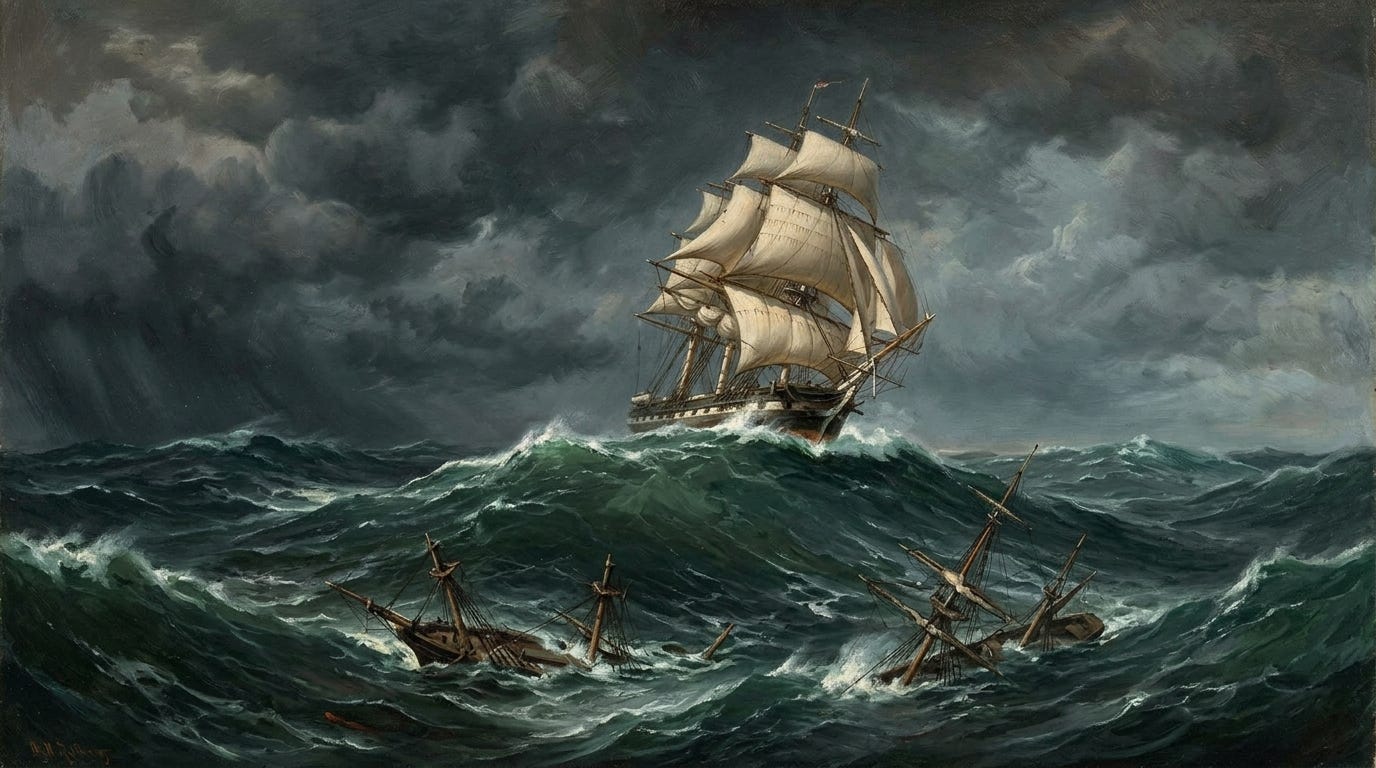
Overnight, entire skill categories are collapsing in value. Entry-level knowledge workers. Junior coders. The people who were promised that doing the thing well enough would be enough.
Meanwhile, electricians, plumbers, and craftsmen are ascending. And quietly, unexpectedly — so are the people who read widely, think across disciplines, understand human nature, and have lived something real. The humanities are having their revenge. The education everyone called impractical turns out to be the only one that transfers.
Here’s what navigating storms since early childhood taught me: the paralysis is the danger. Not the storm.
The storm will sink many. It will fill the sails of the few.
The ones most exposed are not the weak — they’re the talented. The high performers who traded agency for salary. Who chose to be exceptional doers inside someone else’s structure rather than builders of their own. That trade made sense once. The market has stopped honoring it.
The ones who move through this are the directors. The builders. The people who treat AI not as a threat to manage but as an amplifier to master.
More and more of what we do at Xponential is exactly that — fusing this technology with deep expertise to build something the market cannot ignore. The clearer that fusion becomes, the more extraordinary the outcomes we see.
You will win in ways you cannot yet imagine.
None of us can.
↓ In a recent Xponential episode I lay out the exact tools and frameworks driving this. Watch it.
And if something in this post named what you’ve been feeling — here’s what I’d tell you:
The goal isn’t to survive the storm inside a structure that might not survive it either. The goal is to build something that belongs to you. A personal brand strategy rooted in what is deeply, irreplaceably human about you — pointed directly at the people who want to work with you, not the company you happen to work for.
The good news is better than most people realize. A visionary with real AI skill can do the work of ten. The gap between a builder who has mastered these tools and everyone else is widening by the month. You don’t need an army. You need clarity, craft, and the right amplifier.
That’s the work we do at Xponential. A couple of spots are opening in May. If you’ve read this far and something has been building in you — reply with the word May. We’ll have a quick conversation about details and fit.
The Top 1% Use AI Differently—Everyone Else Becomes a Commodity