

Christian Ray Flores here,
These thoughts came during a very long walk with my dog Luna, where I wondered: Why are successful people obsessed with work?
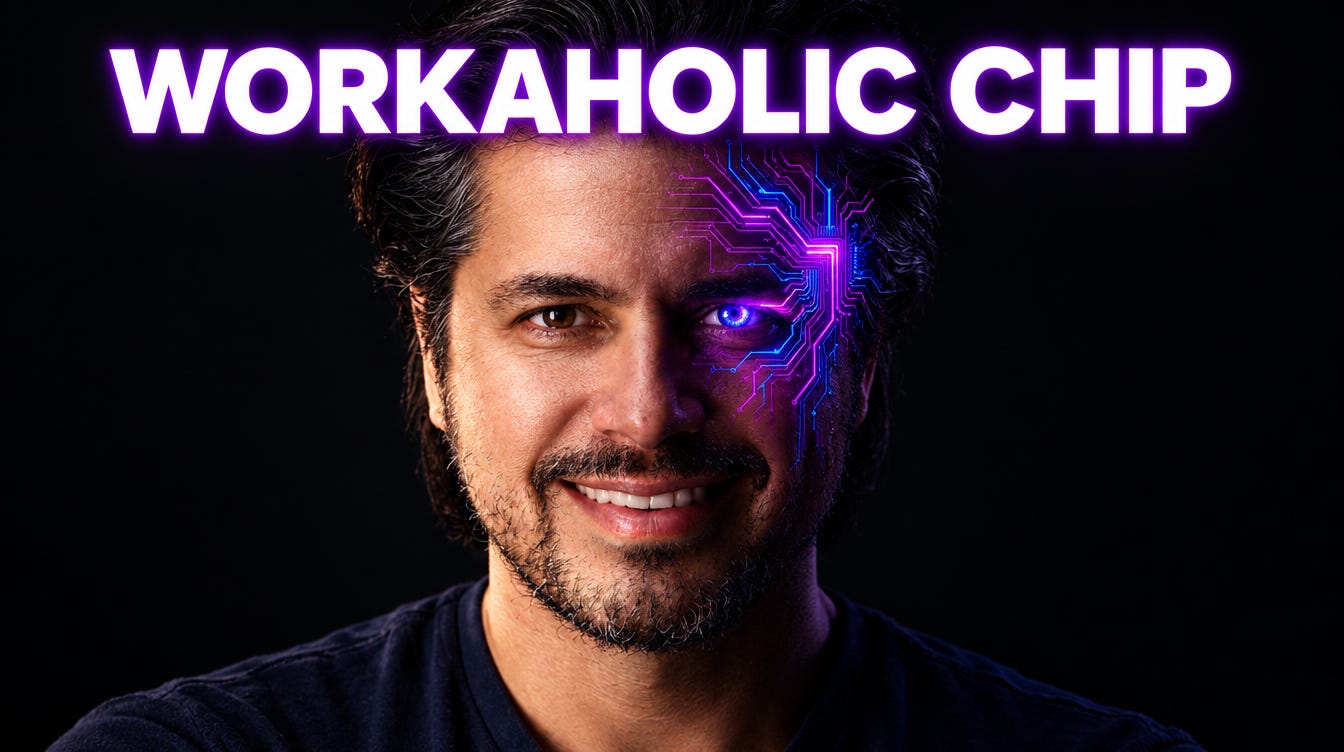
It’s almost like there’s a different chip installed in people that, for better or for worse, most other people simply don’t have. If that’s you or someone you know, read this post to the end. I think you’ll get something valuable out of it.
I want to brag a little about work we’ve been doing that I haven’t been able to share with you until today. A member of Xponential, Ryan Black, is the CEO of Sambazon. They sell products made of Açai berries to 50 countries around the world. If you live in the US and enjoyed an Açai bowl on a hot day, purchased Açai from Costco, or shopped at Whole Foods, it’s probably Sambazon.
We’ve been working on Ryan’s personal brand, Underdog Economics—his mission to help entrepreneurs who feel like underdogs. We’ve just launched his YouTube channel and posted the first of a bunch of stories we’ve produced. Watch this one as an example of how powerful a personal brand can be in telling your story and helping others.
why are successful people obsessed with work?
I spend a lot of time around people who’ve done well. They’ve built something special, have a lot to be proud of, and most of them are still answering email at eleven at night, work weekends and tend to have trouble turn it off.
I may be describing you or your spouse. I’m definitely describing myself for many years of my life.
So today we’ll unpack:
Where does this pattern come from in the first place.
How this quality helps you do better than most, and when it then starts hurting you.
And how the people who redirect this same drive to a different pattern , use it to go to the next level.
It looks like this: You’re fueled by a passion to either achieve something by a certain time or never experience something ever again, to prove something to yourself or someone in you life.
That drive comes naturally to you but it doesn’t to most people and you wonder why. Your mind, focus and dedication is like driving a Ferrari when most people drive a Toyota.
You’ll also take your work home, check your messages during a date with your spouse, if there is a date in your schedule in the first place. You work on stuff while on vacation, that’s if you take vacations. You get on planes, overcome obstacles, move mountains and generally do whatever it takes to succeed. And you invariably do.
Now multiply this by a decade and you have lots to be proud of, people respect you,
So where does this come from?
For a large portion of us this is born in trauma. I’ve traced it back in myself to being an immigrant and an outsider for most of my life. Succeeding was my way of making sure I get acceptance. Yours is probably different. If you look at most of the high achievers you know - most have trauma as some sort of catalyst.
But the reason this obsession with work persists is different than the source.
Arthur C. Brooks is a Harvard professor who spent a good part of his career as a workaholic—ran think tanks, expected everyone to work the way he did. At 48, he realized something: he wasn’t addicted to work. He was addicted to success. He writes that Success addiction works like substance addiction. Your brain gets the hit, needs the next one. You outworked everyone to get where you are, so you believe you have to keep that pace to stay there. The fear of falling behind becomes the thing that drives you forward.
You can’t stop, because stopping means you lose your identity. That same obsession that made you unstoppable — starts hurting you AND your business.
I remember getting my first real success professionally and attaching my identity to that work and success itself taking over from the sense of creative passion as the driver. The minute outward success slowed down or took a dip - my ability to build and create did to.
Daniel Pink’s book Drive was instrumental in my journey to a happy life. The gist of it for the sake of the topic of why successful people are so obsessed about work is this:
Pink defines the 3 core elements of a healthy drive. Mastery - Autonomy - Purpose
This is how it looks in my life. It will look slightly different in yours - but at its core - this is the pattern I see in the people I am around who are both successful, happy and set up for long term growth.
Mastery - I’ve shifted from comparing myself to others and treating my work as a competition to striving to greater and greater mastery in what I do and only comparing myself to myself in the past. The drive does not go away - it is purified and directed and what matters.
Autonomy - it’s a natural extension of mastery. After we’ve matured into someone with mastery, autonomy is simply necessary because it’s the only way for that mastery to shine. This is precisely why I have a personal brand and help people build theirs. It’s creative freedom, the ability to use your mastery at the highest level to serve others.
Purpose - it helps us raise our eyes from what is right in front of us and marvel at the horizon. Asking and answering the question: Why am I here? For me it’s providing love and support to my wife and three daughters, serving the underprivileged in the poorest places on earth, creating valuable content, helping others have exponential impact.
I struggled with the classic obsession with work for years and finally felt the shift on a beach in Santa Barbara. I was watching my kids play and turned to Deb and said “I’m here.” She was puzzled - what do you mean? I know you’re here.
I said - “I mean I’m fully here. With you, heart and soul.” - everything changed after that.
I also realized that I didn’t have real friends, I had what Arthur C Brooks calls “deal friends.”
I now have a fantastic group of real friends.
If this is you. Here’s what it’s costing you right now.
You’re not actually present with your family. You’re there physically, but your attention is split. Your real friendships have withered — you’ve got colleagues and deal friends, but people you can be honest with? Those are gone.
You’ve outsourced your self-worth to external wins, so when something fails, you fall apart.
You’ve lost the joy of creating because you’re too busy managing what you’ve built.
And you can’t stop. You literally can’t stop, because in your mind, stopping equals falling.
That’s what you’re paying for the privilege of staying ahead.
Here’s what I want you to know:
You already have mastery. You’ve already won. So the move is simple — get off the treadmill and audit the three drivers.
Mastery: are you comparing yourself to the market or to your past?
Autonomy: do you actually get to decide how you invest the best of you?
Purpose: is your life rooted in the deepest why of why you’re walking this earth?
When you upgrade those three things, you don’t lose the drive. You redirect it.
Presence comes back. Real friendships come back.
The joy of creating comes back. You get to actually breathe and ironically - truly succeed at the highest level.
If you want to do this systematically with a tribe of people who’ve already won and are tired of the grind — entrepreneurs, business owners, experts building a personal brand — I’d love for you to join my next Personal Brand Accelerator.
We spend 4 days, 1hr/day designing your edge, your offer, your business model, and your brand strategy.
If you read this far, this must have resonated.
It may be describing you or someone you love. Forward this to that person. And if it’s you - make the moves to get off the treadmill and redirect your drive to where it give you a life you actually want.