

Christian Ray Flores here on a rainy in Austin, the rain let down and I pray it holds as I head out horseback riding with two of my daughters.
2 of 3 Spots Have been Filled.
This is for you if you’re a founder, business owner or CEO without a big internal marketing team or an agency on retainer and want help reaching more people with your product or service.
If the fit is right, you can have a strategist and a full team doing moving your marketing fractionally, on a premium level, for less than the cost of one full-time hire. I was looking to get started with 2-3 people to work with this fall. 2 of 3 have joined. If you’re thinking you may be the 3rd, click here and let’s talk.
you may have missed this video episode
Why High Can’t Stop Working? ( And How It Hurts Them).
why competent people feel like frauds?
Why do perfectly competent people battle this feeling of being a fraud?
They feel like their recognition, position, and achievements aren’t earned. They don’t deserve to be where they want to go.
Any minute their tower of lies will crumble and everyone will see the truth.
It’s called imposter syndrome, and most high achievers have it. Ironically, the only people who don’t are the imposters themselves.
So if you’re feeling this, you’re in good company. It means you’re good at something and you care.
I have a front row seat to Imposter Syndrome as I deal with this tension daily with my clients, helping very competent people overcome imposter syndrome flair ups and show up in the full glory of their gifts and mission in life.
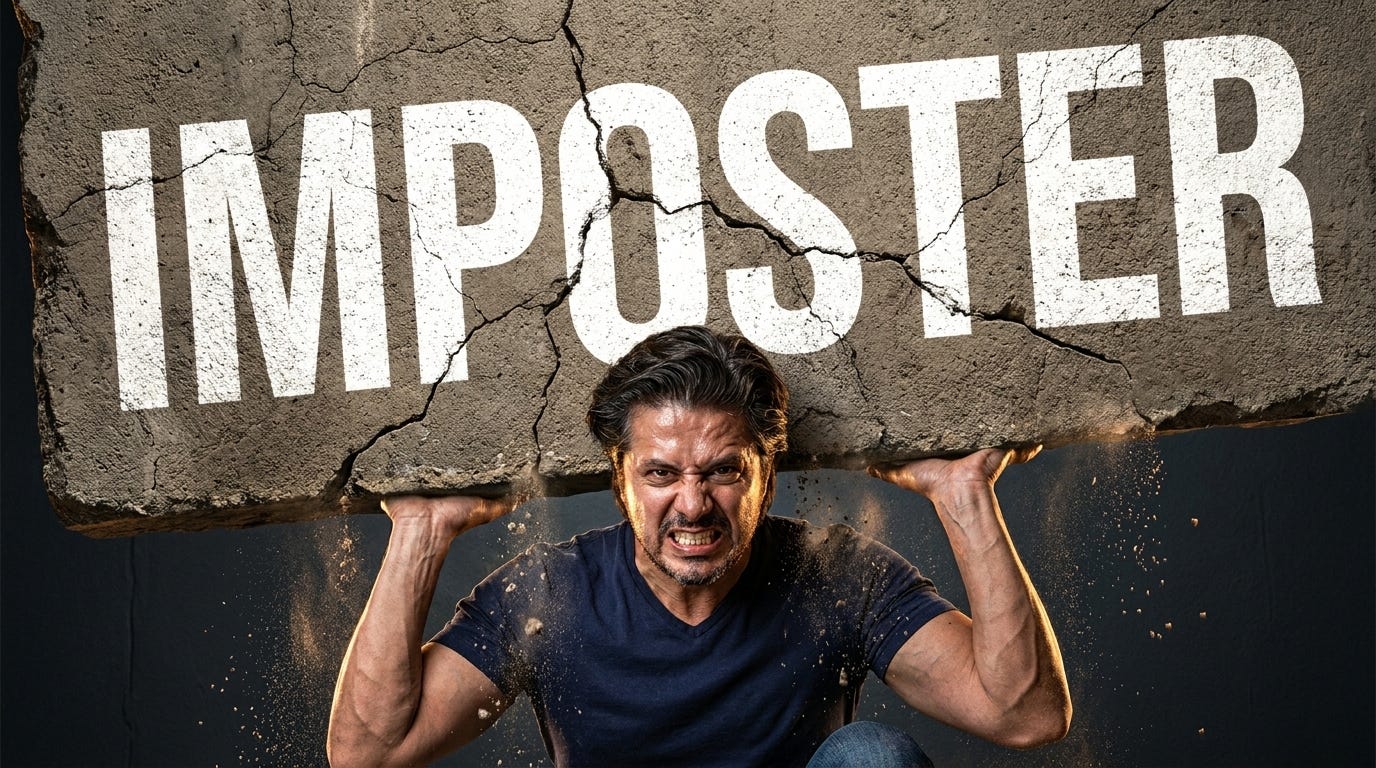
Let’s unpack:
1. How this pesky imposter syndrome works.
2. Why it shows up in the most capable people.
3. What it costs you to give in to it.
4. How to lean into it and see life-changing things happen.
But first a personal story:
I believe regrets can be a good thing.
They are the scars from a self-inflicted wound that make you wiser and more tuned to not repeating the mistake.
I had a wealthy patron in my first career. One day, we were hanging out and he said, “Christian, I think you’re amazing, and if you want, I can become an investor in your brand. I am prepared to put in this much.”
He didn’t say the number. He wrote it on a piece of paper and slid it my way. It was a lot of money. I mean career- and life-changing. It would take me to the stratosphere.
I shrank. I felt unworthy of such an investment. I said no.
I still did very well, but that opportunity to level up on an entirely new level, I did not take it. The person making the offer made it because I he knew I was up to the task. I just didn’t believe him.
So….
1. How does imposter syndrome work? Why is it so powerful?
Because it’s partially true.
If you’re leveling up, you’ve never been where you are.
The people you’re with know why they want you there. They don’t know the gap where your capabilities don’t match exactly. If they knew - I don’t think they would even mind.
But you are very aware of this gap. It makes you feel like a fraud. But you’re not a liar.
You’re just overthinking it.
It happened to me transitioning from music performance in front of a large audience to speaking in front of an audience.
Producing low budget music videos to a hundred-thousand-dollar budget and 50 people on set.
Creating branding for a mom and pop shop and eventually developing a logo for NASA Earth Sciences for three separate projects.
Coaching small businesses, pastors, and nonprofit leaders to coaching CEOs, Tech founders and Executives.
The list never ends. You get it, and you’re probably making a list of your own in your mind.
2. Why does it show up in the most capable people?
Because they’re strivers. They’re constantly stretching for “more.”
In the same way muscle grows to compensate for the gap between what you are comfortable with and a new level of resistance.
When I work with clients, they’re all good at what they do. And they’re all stretching. They’re looking for me to talk them off the ledge and help them lean into this primal imposter syndrome that invariably shows up.
A common question I hear: “Be honest, do you think I can do this?”
And of course, the answer is “yes!” or I wouldn’t be working with them.
Another way Imposter Syndrome shows up is in the temptation to second-guess in the middle of the journey. You’re building a new chapter, a new offer, and you’re constantly and quietly freaking out - what if people don’t accept this new version of you.
Because it is a shift in identity more often than not. An evolution. A transition from being a builder and manager to a thought leader and creator.
They’re perfectly equipped for it, but there’s also a skill gap that needs to be filled: an ability to distill your best practices and communicate them in a compelling way, to write, and to speak to an audience and on camera.
To package expertise into a business model and monetize the value you bring, which translates to a lifestyle you want.
3. What does it cost to not master this very common feeling?
You don’t stretch, you don’t learn, and your next season of impact, income, fulfillment, and fun stays a potential.
One day you look back and…
The book didn’t get written. The business didn’t get built. People who need you most didn’t get your help. The legacy did not get built.
As I said, I believe regrets can be a good thing. One trick I’ve used for decades is imagining my lingering regret if I don’t try the thing.
I realize that the worst that could happen is a non-life changing temporary failure and a learning experience.
But giving in to imposter syndrome kills potential.
Most businesses fail, most channels don’t become well known, and most good ideas die because:
a) They don’t start in the first place because of fear.
b) They give up too early because of imposter syndrome.
I imagine a world where many more people don’t give into imposter syndrome and lean into it instead.
I we would be lightyears ahead as a civilization.
So….
4. How to lean into imposter syndrome
A) Change your circle. Get a mentor or coach who has been where you want to go. Find a tribe of people who are on the same journey. People who will hold you accountable and are as crazy as you are, refusing to cave into fear.
B) Close the gaps by doubling down on new skills. Hardwire the “stretch” into daily and weekly habits. And be annoyingly persistent in those. Whatever the greatest gap is, there’s a system to close it, a skill to learn, a new normal that is no longer a problem.
C) Get comfortable with living with imposter syndrome. Don’t give up until the stretch is no longer a stretch. Then stretch some more.
Someday you’ll look back and be in awe. Your life journey will be a long list of things that happened that end with “Wow!”
My list is long and fraught with moments of intense imposter syndrome that I acknowledged and kept moving anyway.
Have you let imposter syndrome keep you from doing the work you are called to do?
And are you thinking of someone who needs to read this? Forward this to a friend.