

Christian Ray Flores here,
Have you ever had a week where your heart sank, you feel the rug has been pulled from under you? Then you decide to go deep and trust your roots, your foundation? And just like that everything changes and the situation is more than fixed, with the added bonus of you being changed through it. That was my week.
This to say: build your inner game and miracles happen with predictable consistency.
Talking of things being too good to be true but the are, an opportunity:
This is for you if you’re a founder, business owner or CEO without a big internal marketing team or an agency on retainer.
Which usually means your marketing underwhelms you. No strategy or system behind the social. A website that undersells you. Little or no video. No clear direction holding it together.
If the fit is right, you can have a strategist and a full team working fractionally, at premium level, for less than the cost of one full-time hire.
I’m looking to get started with 2-3 people this fall. If that’s you, click here and let’s talk.
why do people get boring after 40?
You know what I mean. Midlife crisis written all over them. Uninspired and uninspiring. A little lost.
And often these are people who are established and respected in their field.
I’m in my fifties. Most of the people I work with are past forty. So I have some insights on this.
This might be you, and I know it’s hard to admit you’ve gotten a bit boring.
So let’s find out if it’s even a real pattern. The three core reasons why this happens. And why acknowledging this humbly is where the biggest breakthrough of a person’s life can come from.

You may already know this is real.
You’ve watched it happen — in life generally and in your own life in particular. And it helps to know you’re not alone and you’re not crazy.
Two economists, David Blanchflower and Andrew Oswald, went looking for this in the data. They took half a million Americans and Western Europeans and what they found was a U. A smile shaped happiness curve. Well-being slides through your thirties, bottoms out somewhere in your mid to late forties, and then climbs back up for the rest of your life. This pattern persisted across seventy-two other countries, developed and developing, and the same smile curve showed up.
I can confirm it from the inside. Most of my forties followed that curve and it wasn’t fun. It was also, I’d say, necessary — a recalibration. This is where the greatest opportunity is - you see the smile that bottoms up in your forties is a natural process but it’s up to you the shape it takes, how low it goes when it goes back up.
More on that in a minute.
But first, why does it happen at all? It’s not about getting older, slower or the world changing way too fast. If age were the reason the curve would keep sliding down and stay there, and it doesn’t — it climbs for decades after the bottom.
There’s something else going on.
I’ve dug into this for myself and for the people I work with, usually founders, business owners building a personal brand, often precicely because they handled this smile curve well. The “boring” phase is gone and they have something of substance to say.
In my view there are three things going on, and they show up in pretty much everyone. How you handle them will be the difference between you spinning your wheels and you taking flight. Almost literally.
the expectation-reality gap.
Youth is optimistic by default — about what you’ll achieve, about what life is going to hand you, about how the whole thing will look when you get there. It never, and I mean never ever plays out like you imagined it.
So there comes a point where the gap stops being theoretical and gets painfully real.
My forties arrived right after I left a well-established chapter of my life overseas and moved to the US. It meant starting from scratch, with no clarity at all about how I fit in. The classic set of insecurities of an immigrant set in. The move was not originally in my plans so the expectation reality gap was massive.
the fuel you run on changes.
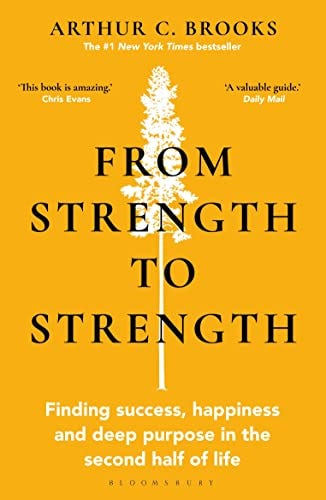
Arthur Brooks writes about this in From Strength to Strength. The first half of life runs on fluid intelligence — you’re flexible, fast, innovative, adaptable, which is exactly why the hustle of building a new thing works so well in your twenties and thirties.
Then something shifts.
Fluid intelligence starts to decline while crystallized intelligence goes up, and you get much better at seeing across disciplines and spaces, recognizing patterns, and wisdom becomes the dominant superpower.
It’s very gradual.
You just notice the old engine doesn’t pull the way it used to, and you assume something’s wrong with you. You now have a choice.
you either reject what’s natural or you accept it.
I interviewed Chip Conley on the pod. He wrote Learning to Love Midlife, and he’s also the modern elder Airbnb’s founders brought in to mentor them.
He says what happens at this stage isn’t a crisis at all, it’s a chrysalis — the same thing that happens to a caterpillar inside a cocoon on its way to becoming a butterfly.
You feel constricted, it’s weird and confusing. And how you respond to this in-between season determines your future.
The caterpillar doesn’t want to give up what’s familiar. You can feel the fluid intelligence declining and your taste for the hustle going with it, and you haven’t found your wings yet, even though your values and deepest desires have already become fundamentally different.
You want meaning now. Depth. To make a mark, to hand your wisdom to somebody, to actually fly instead of crawl. But what if you fall instead of soar? And what does growing those wings even involve?
The cocoon looks boring from the outside, but there’s a lot going on under the surface. A new version of you is being shaped. Boring is good as long as it’s a true chrysalis. It’s temporary. You’re getting ready to fly.
Rejecting the rebirth comes at a cost.
You can’t go back to the old you, it feels forced, tired and often times plain weird. You’ll just work way harder than you want to as a caterpillar instead of experiencing the wonder of flight and the world won’t see you in the full glory of the butterfly.
You’re not alone in that. I’ve been there. Everybody feels constricted in the cocoon phase - but I know this about you - there’s massive change happening just under the surface. What looks boring from the outside is you becoming capable of building something better than anything you’ve built so far.
The happiness curve does go back up, way up — if you embrace the chrysalis and lean into that second curve, your crystallized intelligence, wisdom, mastery, it will mean becoming less of an operator and a maintainer of what you’ve already built, and more of a creator and a thought leader.
Most of my work is with founders, business owners and leaders sitting right at the peak of that second curve — high expertise, high skill, high wisdom — helping them find their wings and building a personal brand that fully represents the best they have to offer.
If that’s you, and ready to grow your wings. Reach out, let’s talk about finding your wings.
And if this was useful, do me a favor and send this to someone you know who needs to read it.